Thursday, November 1, 2018

The Best Web Hosting Services

Quicksprout is reader-supported. That means we use affiliate links. When you click, we sometimes earn a commission. Learn more.

Editor’s note: We compared six of the best web hosting services to see how they stack up. We think most people will be very satisfied hosting their websites with SiteGround, InMotion Hosting, or DreamHost.

There are tons of web hosts out there though — literally hundreds of them. So while we think our top picks are excellent options, we’ll walk you through how to find the best web hosting service for your website, using our six hosts as examples.

  SiteGround InMotion DreamHost Bluehost HostGator GoDaddy
Sign Up Sign Up Sign Up Sign Up Sign Up Sign Up
Quicksprout Pick Quicksprout Pick Honorable Mention Popular Popular Don’t Recommend
Shared hosting plans Start at $4/month Start at $6/month Start at $3/month Start at $4/month Start at $3/month Start at $3/month
24/7 customer support Phone

Chat

Email
Phone

Chat

Email
Email Phone

Chat

Email
Phone

Chat
Phone
Free trial 30 days 90 days 97 days 30 days 45 days 30 days
SSD storage ✔ ✔ ✔ ✔ ✔ On some plans
Free SSL certificate ✔ ✔ ✔ ✔ ✔ On some plans
SSH Access ✔ ✔ ✔ ✔ ✔ ✔
Email hosting ✔ ✔ ✔ ✔ ✔ ✔
Operating system Linux Linux Linux Linux Linux

Windows
Linux

Windows

Our 3 Favorite Web Hosting Providers

SiteGround

  • Quicksprout Pick
  • Best reputation
  • Most robust shared plans

SiteGround is a hugely well-regarded web host, with a rabid fan base and glowing reviews — something especially noticeable in an industry full of fed-up (and vocal) customers. Along with DreamHost and Bluehost, SiteGround is one of WordPress’s three recommended web hosts. Perhaps not surprisingly, then, managed WordPress hosting is built into all of its shared hosting plans — something InMotion considers an upgrade. If your site uses WordPress, this is absolutely a perk: automatic updates, streamlined security, and expert technical support that are all just part of the package.

SiteGround is widely considered to be a technology leader, particularly in the shared hosting space where all hosts are duking it out for business. Its servers are ultra fast and extra secure, and SiteGround is constantly deploying new updates and technology to keep them that way.

While all its shared hosting plans are powerful, SiteGround is especially well-known for its highest-tier shared plan, GoGeek, which is suped up with tools developers will find especially useful, including a staging server and Git repo creation. Lots of small business and personal websites will probably find this overkill, but if your needs are more complex than the basics, SiteGround has a lot to love.  

That said, once you blow through SiteGround’s introductory pricing (you choose contracts for one, two, or three years) your plan’s price triples: its lowest tier of shared hosting jumps from $4/month to $12 and its highest tier jumps from $12/month to $26. That doesn’t feel great. It also has the shortest trial period of all our top picks: only 30 days.

In addition to shared hosting, SiteGround offers upgrades to cloud hosting and dedicated servers.

InMotion Hosting

  • Quciksprout Pick
  • Best for beginners
  • Most impressive customer support

InMotion may not look flashy, but it’s a solid web host with truly excellent technology, a wide assortment of plans, and a legion of longtime customers. Its massive self-help knowledge base is the industry standard, and customer support is among the best. Don’t believe it? Try for yourself. InMotion’s 90-day free trial period for shared hosting is one of the longest around, second only to DreamHost’s 97-day trial.

There’s not a lot of hierarchy in InMotion’s plans. Upgrading from its lowest-tier shared plan, Launch, to Power or to Pro doesn’t unlock access to lots more slick tools or free add-ons. Upgrading is simply designed to accommodate websites that require more oomph — not to upsell. It’s a straightforward approach we like, especially for small businesses and websites that aren’t overly complex.

InMotion is one of the only web hosts that doesn’t offer some sort of special introductory pricing. With shared hosting starting at $6–$7/month, it’s a slightly higher price point to start out, but that price will remain pretty consistent every time you re-up your plan.

In addition to shared hosting, InMotion offers upgrades to managed WordPress hosting, VPS hosting, and dedicated servers.

DreamHost

  • Honorable mention

Like SiteGround, DreamHost is one of WordPress’s three recommended hosts, and includes managed WordPress hosting in its basic shared plans (it also offers a managed plan with more bells and whistles called DreamPress). Like InMotion, it has an industry-leading free trial period — a full 97-day money-back guarantee — and transparent pricing that doesn’t increase after your initial contract. It’s the best of both worlds.

DreamHost is notable for being completely customized, skipping the customary cPanel that SiteGround, InMotion, and so many other web hosts use for a control panel it’s built and tailored in-house. Think of it a little like Apple versus Android: Dreamhost customers love it, but it’s not universally compatible should you ever migrate to or from a different host.

In addition to shared hosting and managed WordPress hosting, Dreamhost offers upgrades to VPS and cloud hosting, as well as dedicated servers.

Ratings and reputation don’t always match up

  SiteGround InMotion DreamHost Bluehost HostGator GoDaddy
Sign Up Sign Up Sign Up Sign Up Sign Up Sign Up
Money-back guarantee 30 days 90 days 97 days 30 days 45 days 30 days
Phone 24/7 24/7 ✘* 24/7 24/7 24/7
Chat 24/7 24/7 Only certain hours 24/7 24/7 Only certain hours
Email 24/7 24/7 24/7 24/7
Percentage of 5-star user reviews on

WhoIsHostingThis
92%

(1954 total reviews)
67%

(549 total reviews)
54%

(251 total reviews)
43%

(480 total reviews)
37%

(572 total reviews)
27%

(584 total reviews)
Trust Pilot ★★★★★

(1477 reviews)
★★★

(108 reviews)
★★★

(473 reviews)


(115 reviews)


(401 reviews)
★★

(3,113 reviews)
CNET 4.5 / 5 5 / 5 5 / 5 4 / 5 4.5 / 5
PC Mag 4 / 5 4 / 5 4.5 / 5 4.5 / 5 4 / 5


Two other popular web hosts to consider

Bluehost and HostGator are both hugely popular web hosts that rank highly in tech publications like PCMag and CNET. There are good reasons why. HostGator has month-to-month contracts available on all its plans, the option to purchase a dedicated IP address, plus Windows-based servers — a little less common than Linux. Bluehost’s shared hosting plans all have some sort of built-in managed WordPress hosting features, and its offers contracts as long as five years, which will score you some really low prices. 

But user reviews for both providers don’t line up with those industry publication rankings. User reviews always need to be taken with a grain of salt (was someone just having a bad day?) but from a 30,000-foot view, we’re not convinced their customer service can compete. If you want to try them out anyway, both offer money-back guarantees — 45 days for HostGator’s and 30 days for Bluehost.

A hosting service we don’t recommend

We recommend avoiding GoDaddy. It has a nice variety of plans and price points, but truly abysmal user ratings. They make sense: Its support documentation is all over the place, and customer service verges on laughable —  phone wait times are long, chat is only available during certain hours, and it doesn’t offer any email support at all. You can absolutely do better.

How to Find the Best Web Hosting Provider for You

First, get a handle on what you actually need from your web host

The first thing to understand is how much web hosting your site or sites need to function well, without paying for what you don’t need. It starts with a game of Match the Specs.

Knowing your site’s stats (or what you predict your site’s stats will be) before you start comparing options and offers will help prevent that upsold-at-the-register feeling. Here are the basic ones to know:

    • Storage: How many gigabytes of space does your website need?
    • Number of sites: How many domains are you looking to host?
    • Bandwidth: How many visitors do you get in a month? Do you plan on any high-volume traffic surges (for example, from a viral blog post, a big PR push, Black Friday)
    • Supported technology: What programs, features, and apps does your site use (for example Perl, Joomla, a shopping cart)? What operating system is your website compatible with?

Match what you need with what each host offers, and try not to get too distracted by the stuff a host offers that you aren’t going to use — Bluehost isn’t a better host than DreamHost because it supports Drupal if you’re never going to use Drupal.

At the shared hosting level — the most common and where most websites start out — all six providers we looked at are fairly tit for tat: two or three tiers of plans with a variety of perks, functionality, and resources that increase with each tier. Unless there are specific conditions you’re trying to meet (you really do need that Drupal, for instances) at a pure specs point of view, we think you’ll be happy with any of them.

What stands out?

1. SiteGround’s plans appear quite a bit smaller than the competition, ranging from 10GB–30GB of storage and approximately 10K–100K monthly visitors, compared to 100GB of storage for GoDaddy’s lowest tier, and unlimited storage and bandwidth on most of the rest. Don’t let that dissuade you, especially if you like the rest of what SiteGround’s got going for it. For lots of websites, 10–30GB is plenty, especially sites that aren’t streaming or hosting gigantic media files.

What does unlimited and unmetered mean?

Many web hosts advertise “unlimited” or “unmetered” bandwidth and storage on their plans, which means there are no set thresholds for the amount of resources your website is allowed to use at any given time. But, as Hostgator puts it, “unlimited doesn’t mean infinite.”  If you’re negatively impacting the other sites on your server, every web host in the world will throttle your usage and/or suspend your account until you optimize your site or upgrade to a higher plan. Most let you know you’re exceeding your usage with an email a day or two before they take action.

Even though this sounds alarming, most websites will likely never experience this. (Bluehost claims that 99.95 percent of its 2 million websites stay within “normal” usage.)

2. SiteGround, DreamHost, and Bluehost all include some kind of managed WordPress hosting into their shared hosting plans, instead of considering it an upgrade. (SiteGround also includes managed Joomla hosting in its shared hosting packages.) It’s not all that surprising: These are the three web hosts WordPress recommends to its many millions of users, and it tracks that they would prioritize those users needs into their core offerings.

WordPress will absolutely work seamlessly on all shared web hosting plans, managed or not. With managed hosting, though, everything is designed with WordPress in mind: it comes pre-installed, core updates happen automatically, customer support has more specific expertise. If you like the sound of that, you may want to skip shared hosting altogether and shop for managed WordPress hosting instead.  

3. Most web hosts run Linux on their servers. If your website requires a Windows operating system, Hostgator and GoDaddy are your two options from these six.

Shared hosting comparison

  SiteGround InMotion DreamHost BlueHost HostGator GoDaddy
Lowest Tier StartUp Launch Shared Starter Basic Hatchling Economy
Initial price $4/month $6–7/month $3–5/month $4–6/month $3–11/month $3–8/month
Normal price $12/month $6–7/month $3–5/month $8–9/month $11/month $8/month
Bandwidth ~10K visitors/month* Unlimited Unlimited Unmetered ~7-8K visitors/day* Unmetered
Storage 10GB Unlimited 50GB 100GB Unmetered 100GB
Number of sites 1 2 1 1 1 1
SiteGround InMotion DreamHost BlueHost HostGator GoDaddy
Middle Tier GrowBig Power Plus Baby Deluxe
Initial price $6/month $8–10/month $6–8/month $4–12/month $5–11/month
Normal price $20/month $8–10/month $11–13/month $12/month $11/month
Bandwidth ~25K visitors/month* Unlimited Unmetered ~7-8K visitors/day* Unmetered
Storage 20GB Unlimited Unmetered Unmetered Unmetered
Number of sites Unlimited 6 Unlimited Unlimited Unlimited
SiteGround InMotion DreamHost BlueHost HostGator GoDaddy
Highest Tier GoGeek Pro Unlimited Choice Plus Business Ultimate
Initial price $12/month $15–19/month $8–11/month $6–8/month $6–17/month $8–17/month
Normal price $35/month $15–19/month $8–11/month $15–17/month $17/month $17/month
Bandwidth ~100K visitors/month* Unlimited Unlimited Unmetered Unmetered Unmetered
Storage 30GB Unlimited Unlimited Unmetered Unmetered Unmetered
Number of sites Unlimited Unlimited Unlimited Unlimited Unlimited Unlimited
Operating system Linux Linux Linux Linux Linux

Windows
Linux

Windows

*SiteGround and Hostgator both offer unmetered bandwidth, but provide recommended traffic thresholds

Then, put customer service to the test

Beyond any basic “does my website have what it needs to function well,” customer support is the single most important thing a web host can offer. Think of it like health insurance. It doesn’t matter how robust the policy is. If the claims process is a nightmare, you’re going to switch providers.

Customer support can be split into live support — phone calls, help desk emails, and chat — and knowledge centers, which include everything from help articles to tutorials to community forums to blogs. Both live and self-help support are vital for when you’re having issues in set-up or performance.

When it comes to a knowledge center, you want a catalog that’s well-organized and easy to search, with a huge library of hyper-specific content. Bonus points for active moderators who are answering questions.

What stands out?

1. Out of our six hosts, InMotion’s support center is the one to beat. It has a gigantic database of detailed articles, tutorials, videos, and FAQs, plus a well-moderated community forum. If something doesn’t make sense, keep on scrolling: InMotion support staff is present in every comments section with advice, recommendations, and clarification — the only one of our six providers to do so.
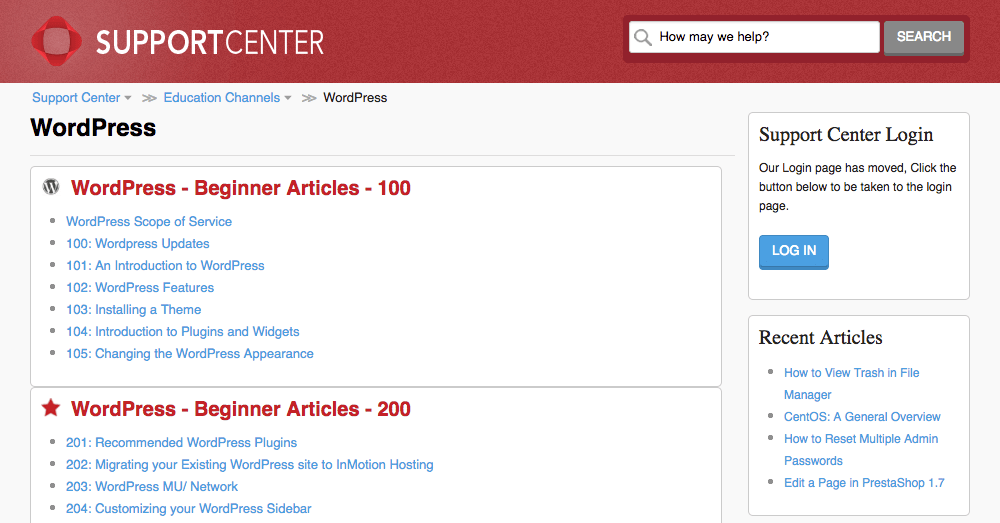
InMotion WordPress support page

InMotion’s support center is through and easy to navigate.

2. SiteGround and DreamHost also have great resources that are complete, informative, and intuitively organized. Even though the quality of the content in HostGator’s support is rich, it looks looks like it was designed in the mid-90s and never updated.  

3. Bluehost’s and GoDaddy’s organization is particularly atrocious. Go straight to the search bar — better yet, Google what you’re looking for. Don’t even bother browsing.

As for live support, your priorities are fast access and nuanced, specific help from people who know what they’re talking about. That’s tricky to evaluate without being a long-term customer.

One way is to get a sense of a web host’s reputation, particularly over the past two years (all six of our web hosts have been around since at least the early 2000s — lots has happened since then).

What stands out?

1. SiteGround is overwhelmingly the crowd favorite out of the six hosts we looked at. It’s the de facto recommendation of Reddit users, and hugely well-regarded everywhere else: like we mentioned, it’s one of only three web hosts recommended by WordPress (DreamHost and Bluehost are the others), and has over twice as many five-star user reviews as any other provider on WhoIsHostingThis.

2. If you start reading user reviews, you’ll notice how many are focused on customer support. This is especially apparent with Bluehost, HostGator, and GoDaddy, whose products rank high with industry publications like CNET and PCMag, but who are ravaged by customers unhappy with the the support they’re provided.

Ratings and reputation don’t always match up

  SiteGround InMotion DreamHost Bluehost HostGator GoDaddy
Percentage of 5-star user reviews on

WhoIsHostingThis
92%

(1954 total reviews)
67%

(549 total reviews)
54%

(251 total reviews)
43%

(480 total reviews)
37%

(572 total reviews)
27%

(584 total reviews)
Trust Pilot ★★★★★

(1477 reviews)
★★★

(108 reviews)
★★★

(473 reviews)


(115 reviews)


(401 reviews)
★★

(3,113 reviews)
CNET 4.5 / 5 5 / 5 5 / 5 4 / 5 4.5 / 5
PC Mag 4 / 5 4 / 5 4.5 / 5 4.5 / 5 4 / 5

But the true test of support quality is to experience it yourself, and that’s where free trials come in. All six hosts have some sort of money-back guarantee on their shared hosting plans, which means you can set up your website and see what you think of the service with relatively low stakes — just your time and any add-on fees you opt into, like paying for domain registration. We recommend going to town with customer support during that trial period. Get on live chat, open tickets, hop on the phone as much as possible to see if you like what you’re being served up.

What stands out?

1. DreamHost and InMotion are the real leaders of the money-back guarantee, with 97- and 90-day free trial periods respectively. These are the best you’re going to find from any web host, anywhere, and give you a lot of time to test out customer support, tools, and functionality. HostGator comes in second with a 45-day trial. Every other host offers a nice-to-have but swift 30 days.

2. SiteGround, InMotion, and Bluehost put a lot of resources into their support channels, with 24/7 access across phone, live chat, and email.

3. You have to pay money to speak on the phone with someone from DreamHost: $10 for one callback, or you can purchase packages of three callbacks for $15.

4. HostGator and GoDaddy both lack any email customer support.

Customer support comparison

  SiteGround InMotion DreamHost Bluehost HostGator GoDaddy
Money-back guarantee 30 days 90 days 97 days 30 days 45 days 30 days
Phone 24/7 24/7 ✘* 24/7 24/7 24/7
Chat 24/7 24/7 Only certain hours 24/7 24/7 Only certain hours
Email 24/7 24/7 24/7 24/7

* DreamHost customers can request a callback from technical support, but will be charged $10

Try not to worry about uptime too much

Beyond customer service, the most common complaint you’ll read from customer reviews is about uptime – or rather, lack thereof. Uptime is vital to your business: in 2013, Amazon.com famously went offline for 40 minutes and lost $4.8 million.

Every single web host in the world strives to have 100 percent server uptime, but there’s unfortunately no industry standard to evaluate how well they do. Lots of web hosting review sites do personal tests to try and gauge server performance, including WhoIsHostingThis and Web Hosting Facts, but since these tests only look at one site at a time, and often for short amounts of time, they are best used as indications, not gospel. That said, all six of our web host sites perform well in these micro tests, with reported uptimes over 99.9 percent.

To try to avoid the “just trust us” promise of near-perfect uptime, most hosts provide some sort of guarantee of at least 99.9 percent uptime. However, that guarantee isn’t much of a guarantee. It just means your bill can be discounted in the event of any unplanned downtime. There’s a lot of fine print on these guarantees, too, including not accepting self-reported or third-party uptime data, and not providing refunds for downtime that was out of the host’s control (for example, a hurricane).  

What stands out?

1. Bluehost is one of the only host to offer no uptime guarantee, and instead just says most of its downtime issues are resolved in 15 minutes.
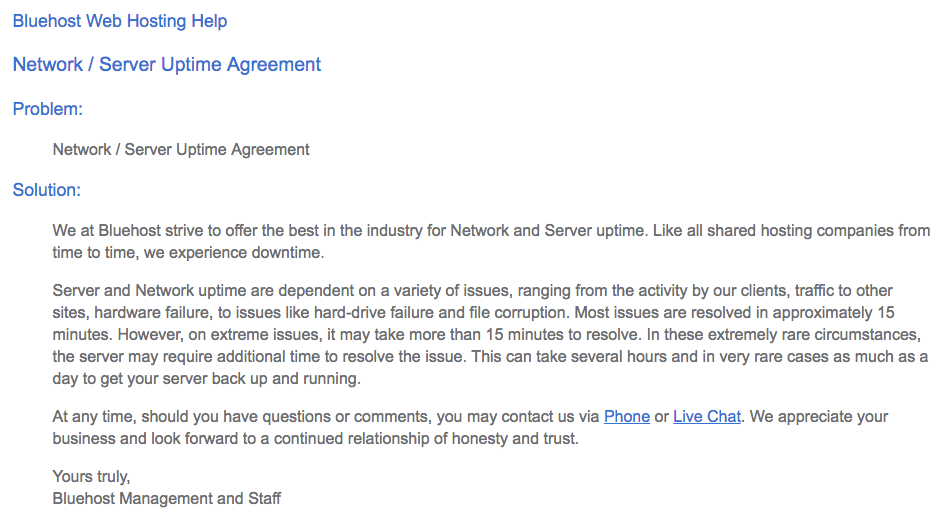
Bluehost uptime agreement text

We’re not impressed by Bluehost’s no-promises uptime agreement

2. SiteGround zooms out to view uptime annually instead of monthly, like most everyone else. If your average annual uptime is below 99.9 percent, you get one month of free hosting. SiteGround is also the most transparent when it comes to its uptime, and lists both its cumulative 12-month uptime and the previous month’s uptime right on its site.

3. DreamHost zooms in to view uptime hourly. For every hour of service interruption below 100 percent uptime, you get a day of free hosting (capped at 10 percent of your bill). The caveat: money back is only eligible when you manually flag that you think your service is sub-par. DreamHost doesn’t track it automatically.

Uptime guarantees aren’t exactly guarantees

  SiteGround InMotion DreamHost Bluehost HostGator GoDaddy
Uptime guarantee 99.9% annually 99.999% monthly* 100% hourly 99.9% monthly 99.9% monthly
If it’s below that: 1 month of free hosting 1 month of free hosting 1 day of free hosting 1 month of free hosting 5% off next month’s bill

*Only available on InMotion’s highest-tier shared hosting plan

Migrations matter, especially if your website already exists

Frustrating support and downtime — particularly when they’re combined — are the most common reasons to abandon one host and join another.

It’s always possible (and free) to migrate your existing site manually to a new web host (another reason those knowledge bases are so critical). But it gets more challenging the bigger and more complicated your site is, which is why web hosts often provide some sort of “managed” migration to ensure it’s done right.

What stands out?

1. InMotion’s managed migration policy is the most generous: three are free, and then it’s just $10 per transfer after that.

2. The oddest policy is Bluehost’s, which requires you to purchase five managed migrations at a time for $150. The economics aren’t so bad if you have five sites to migrate — less so if you only have one or two.

3. DreamHost is also unique insomuch as it is the only host out of the these six that doesn’t use cPanel, but rather its own custom control panel. Transferring an existing site in and out of DreamHost is always going to be a manual process managed by you. The exception is WordPress sites, whose migration DreamHost will manage for a whopping $99 each.  

What’s cPanel?

Your control panel is the everything-in-one-place dashboard you use to manage your web hosting, whether its opening help tickets or installing a new app onto your site. cPanel is the most common “brand” of control panel and works with Linux operating systems. (The most common one you’ll see with Windows-based operating systems in Plesk.)

Every web host can customize its cPanel to look and act a certain way, but all cPanels are compatible with each other — think Android on your phone or tablet. DreamHost is more like Apple, in that it has built its own control panel that’s only compatible with itself.

Other web hosting specs to look for

Backups: It’s best practice to manually backup all your files and databases and store them on separate machines — we consider it one of the top 4 content areas you should worry about. But lots of web hosts advertise complementary backups to act as a kind of auto-save in case you corrupt a file, delete something vital, or otherwise break your website.

SiteGround’s backup policy is the beefiest and most integrated as a feature. It automatically backs everything up every day. For its mid- and highest-tiered plans, restoring those backups is free; the lowest-tiered plan is $20 per restore. GoDaddy offers a similar service, but for $2/month.

Everyone else treats automatic backups and restores as worst-case scenarios: Somehow you’ve wiped out your entire website and you forgot to make any manual copies.

  • Bluehost offers complementary daily backups and free restores across all its plans, but it caveats that it is at Bluehost’s discretion and in no way guaranteed. For more dependable website backups, it offers an add-on service called CodeGuard that provides daily backups and restores. CodeGuard is included for free in its highest-tier shared hosting plan.
  • With InMotion, only sites under 10GB are automatically backed up; you can restore a backup for free once every four months, or pay $40.
  • Likewise, HostGator only automatically backs up your site if it’s under 20GB. Getting a copy and support to restore will put you out $25.
  • DreamHost does a daily backup that’s kept for a week or two; support will help you restore your site for free if you somehow wipe everything out.

SSD storage: Solid State Drive technology is notably faster than regular “spinning” hard drives, which in turn means content is delivered to your website and your website’s visitors faster. It’s pretty common among well-known web hosts to include SSD storage in even lower-tier shared hosting plans. GoDaddy is the only one of the six hosts we looked at that doesn’t offer it on its basic shared hosting. You have to spring for its managed WordPress hosting to get SSD storage.  

SSL certificates: Certificates for Secure Sockets Layer encryption (SSL) are like internet passports that confirm your website is secure enough for your visitors to submit sensitive data, like credit card information and passwords. It’s considered best practice to have SSL certification — in fact, Google considers it as a factor in how your site will show up in search rankings.

Most web hosts include basic SSL certificates for free in their shared hosting plans (although GoDaddy only offers it with its highest-tier shared hosting plan). That basic SSL certificate should be enough for most websites. More advanced encryption is needed if your website is also connected with a physical presence, like a brick and mortar store. Those suped-up SSL certificates are available for purchase through all web hosts.

SSH access: Secure Shell access means you have a secure channel straight into your account to manage files and databases. It’s a feature that’s critical if you’re have a web developer or technically-inclined site administrator who wants to manage and troubleshoot everything themselves. All six web hosts provide SSH access.

Email hosting: If your web host includes email hosting, it means you’ll have access to a customized email address and room to store your emails. Lots of web hosts offer this, often for free. SiteGround, InMotion, BlueHost, and GoDaddy include unlimited email hosting on their lowest-tier shared plans; all six hosts include it on their highest-tier plans.

It’s worth keeping in mind that email isn’t stored in a separate place — it all pulls from the same server space as the rest of your site, which means it will impact how much room is “left over” for you to use. If that doesn’t sound ideal — maybe your website is already pretty weighty — your web host isn’t your only option for getting a custom email address. GSuite (aka GMail for businesses) and services like Hover also provide email, and often it’s a more robust, more intuitive solution, like what you’re used to with your personal email. Lots of small business owners prefer keeping their email and websites on separate hosts: if your web host is also your email host and it goes offline, you’ll be without access to email. Quelle horreur.

Look for room to grow long-term

A typical upgrade pattern for a new website is to start with shared hosting, max that out, and then jump to VPS, cloud, or dedicated. WordPress websites might take a pit stop in Managed WordPress hosting for awhile, too — which, depending on the host, could be on a VPS server (like Bluehost) or cloud server (like DreamHost and HostGator).

It’s time to upgrade when your site’s size and traffic over-burden your current plan. Sometimes, the host will let you know it’s time to upgrade — that will happen if you’re, say, overwhelming a server and making everyone else’s sites on that server slow down. Another reason to upgrade is if you’re ready for more functionality, customizability, and autonomy: upgrading usually gets you access to a more robust toolkit.

What stands out?

1.  SiteGround is unique in that it leaps from shared hosting straight to cloud, without the traditional VPS onramp.

2. InMotion is a little less modern than its competition by not offering some sort of cloud hosting solution.

3. GoDaddy has created another stepping stone between shared hosting and full-blown VPS with something called “business hosting” — basically the power of VPS with the straight-forward cPanel interface of shared hosting.  

No web host wants to put a ceiling on your website’s growth

  SiteGround InMotion DreamHost BlueHost HostGator GoDaddy
Shared ✔* ✔ ✔* ✔* ✔ ✔
Managed WordPress ✔ ✔ ✔ (cloud) ✔ (VPS) ✔ (cloud) ✔
VPS ✔ ✔ ✔ ✔ ✔
Cloud ✔ ✔ ✔ ✔ ✔
Dedicated ✔ ✔ ✔ ✔ ✔ ✔

*Includes managed WordPress hosting in shared hosting plan

Not sure what all the different types of web hosting are? Here’s a breakdown:

An easy analogy is homes – GoDaddy has a nice little illustration of this. Shared hosting is like an apartment complex. One big building (the server) hosts lots of different residents (websites), who share the building’s resources (storage, bandwidth, often an IP address). This is an excellent solution for a lot of small and midsize websites, but the downside is if someone on the server hogs too much of the resources, it impacts everyone – imagine sharing the basement laundry with another resident who wants to wash all their sheets and towels and clothes every day. Web hosts offer a range of shared hosting plans. The higher the tier, the “nicer” the apartment building: fewer residents, more washing machines.  

A virtual private server (VPS) is more comparable to a townhouse — you’re still sharing a building with other residents, but far fewer than in a shared hosting apartment building. Plus you get more flexibility and control over your space. That’s because the server makes virtual copies of itself, and each resident gets its own copy: you get your own IP address, private access, your own washing machine.

Dedicated hosting is like a house and there’s only one resident: your website. A dedicated server is designed to accommodate huge traffic — you can do all the laundry you want! — and requires a fair amount of upkeep that you or your webmaster is on the hook for. That lawn isn’t going to mow itself.

Not every web hosting service offers cloud hosting — it’s the newest form — but think of it as owning multiple residences. If there’s a problem at one of your servers, your website will instantly go stay at one of the others. In theory, your website will never go offline.

Lastly: WordPress hosting. WordPress is the most common CMS available. As such, most web hosting providers offer managed WordPress hosting, where the plan is designed with WordPress as its primary consideration: WordPress comes pre-installed, WordPress core updates are automatically applied, your server’s security might be more specifically tailored to what WordPress prefers.

This isn’t to say other hosting plans aren’t good for WordPress. They are all designed to be seamlessly compatible. But think of managed WordPress hosting like a yard service: it’s going to water your lawn and trim the hedges automatically.

Always pay for domain privacy

If you’re creating a new website, you’ll need to register a domain. All six web hosts allow you to register with them (sometimes for free, sometimes for a fee) even though it’s not required — you can register a domain with Namecheap or GoDaddy and still be hosted by SiteGround or InMotion.

When you’re purchasing that domain, always opt into domain privacy, which means proxy contact information from the domain administrator will be submitted to the WHOIS registry. If you don’t opt in, you will be spammed. A lot. Domain privacy usually runs $1–2/month and is billed annually.
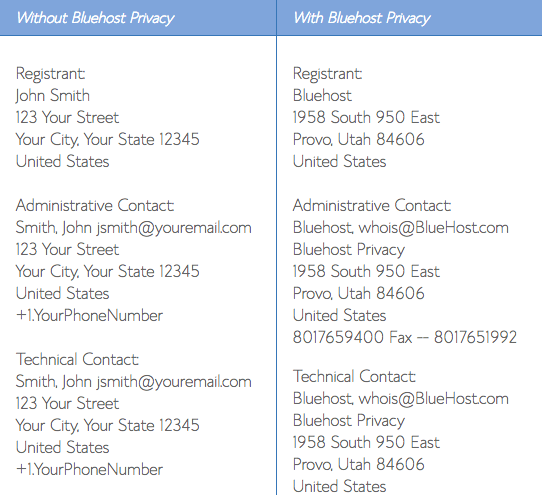
Example of WHOIS contact information before and after Bluehost domain privacy

Always, always, always get domain privacy. Or you’ll be sharing lots of personal info. 

DreamHost includes domain privacy for free with all its shared plans; Bluehost offers it for free on its highest-tier shared plan.

Recap: The Best Web Hosting Services

Quicksprout?d=yIl2AUoC8zA Quicksprout?d=qj6IDK7rITs Quicksprout?d=I9og5sOYxJI

source http://www.quicksprout.com/best-web-hosting/


source https://derekpackard.com/the-best-web-hosting-services/

Twitter’s spam reporting tool now lets you specify type, including if it’s a fake account

Twitter is adding more nuance to its spam reporting tools, the company announced today. Instead of simply flagging a tweet as posting spam, users can now specify what kind of spam you’re seeing by way of a new menu of choices. Among these is the option to report spam you believe to be from a fake Twitter account.

Now, when you tap the “Report Tweet” option and choose “It’s suspicious or spam” from the first menu, you’re presented with a new selection of choices where you can pick what kind of spam the tweet contains.

Here, you can pick from options that specify if the tweet is posting a malicious link of some kind, if it’s from a fake account, if it’s using the Reply function to send spam or if it’s using unrelated hashtags.

These last two tricks are regularly used by spammers to increase the visibility of their tweets.

Often, high-profile Twitter users will see replies to their tweets promoting the spammers’ content. For example, check any of @elonmusk’s thread for crypto scammers’ tweets — a problem so severe, that when Elon played along one time as a joke, Twitter locked his account.

Using hashtags, meanwhile, allows spammers to get attention from those people searching Twitter’s Trends.

And of course, spammers are often posting prohibited content, like malicious links, links to phishing sites and other dangerous links.

Activity that attempts to manipulate or disrupt Twitter’s service is not allowed. We remove this when we see it.

You can now specify what type of spam you’re seeing when you report, including fake accounts. pic.twitter.com/GN9NKw2Qyn

— Twitter Safety (@TwitterSafety) October 31, 2018

But Twitter users will probably be most interested in the new option to report fake accounts.

There’s been a lot of name-calling on Twitter today following the emergence of reports of Russian bots and trolls flooding Twitter, in an attempt to influence U.S. politics with disinformation. Often, users in disagreements on the site will call someone “bot” as a way to shut down a conversation.

Twitter itself has been suspending real bots left and right in recent months. It deleted 200,000 Russian troll tweets earlier this year, for example, and suspended more than 70 million fake accounts in May and June, according to reports.

Now users will be able to report those accounts they believe to be bots, as well.

To what extent Twitter will rely on these user-generated reports over its own algorithmic-based bot-detection systems, or other factors (like IP addresses or suspicious behavior), is unclear.

It’s also unclear if people can ban together to mass report an account as “fake” in an attempt to remove a real person’s account. But someone will surely soon test that out.

Prior to the change, users were able to report spam but not the type of spam, Twitter’s documentation today still confirms.

Twitter tells us the updated reporting flow will simply allow the company to collect more detail so it can “identify and remove spam more effectively.”

The feature is live now on the web and in its mobile apps.

source https://techcrunch.com/2018/10/31/twitters-spam-reporting-tool-now-lets-you-specify-type-including-if-its-a-fake-account/


source https://derekpackard.com/twitters-spam-reporting-tool-now-lets-you-specify-type-including-if-its-a-fake-account/

Transcript of Communicating with Empathy in the Digital World

Transcript of Communicating with Empathy in the Digital World written by John Jantsch read more at Duct Tape Marketing

Back to Podcast

Transcript

This transcript is sponsored by our transcript partner – Rev – Get $10 off your first order

John Jantsch: Has technology in the virtual world that we live in made it easier to communicate or harder? Sure, in some ways it’s made it easier to have distributed staff and have clients all over the world, but we’ve lost the emotional impact of our communication when we don’t have that face-to-face. Think about our emails that maybe don’t quite get the point across that we were trying to make. We have to learn how to communicate differently in a virtual world. And in this episode of the Duct Tape Marketing podcast, I visit with Dr. Nick Morgan, author of Can You Hear Me?

This episode of the Duct Tape Marketing podcast is brought to you by CloudPhone. You can get big-time modern virtual phone functionality at a fraction of the cost. In fact, keep listening. I’m going to tell you how to get 50% off.

Hello, and welcome to another episode of the Duct Tape Marketing podcast. This is John Jantsch and my guest today is Dr. Nick Morgan. He is considered one of America’s top communications coaches and he’s the author of a book we’re going to talk about today. Can You Hear Me? How to Connect with People in a Virtual World? So, Nick, thanks for joining me again.

Nick Morgan: John, great to be back with you.

John Jantsch: There are lots of pros to this virtual world. I mean, I’ve been doing this a long time, and I mean, it used to be if somebody wasn’t in your town, and you couldn’t get in the car and go drive to them, you couldn’t have them as a customer. Certainly, you couldn’t have an employee that wasn’t there kind of sitting at a desk. So a lot of pros, but obviously your book suggests that there are some inherent hurdles as well. So you want to kind of map out those hurdles that we maybe haven’t considered that now so many of us are doing a lot of our work virtually.

Nick Morgan: Yeah, absolutely. First I should acknowledge you’re absolutely right, that there are huge advantages to the virtual world. That’s why it’s taken the work world and a lot of our personal lives as well by storm. And the greatest acceleration has been in the last decade with mobile phones; they really transformed our lives. After a decade, it’s just become clear that in spite of what we thought at the beginning, it’s not all good. So on the positive side, we get what they call a reduction in friction out in Silicon Valley. Meaning it’s much easier to send emails and everything else. It’s also virtually free. Your reach extends enormously and as you said, it means that we can do things like work remotely and all that sort of thing. There’re huge amounts of good. It’s not going away. I’m an audiophile myself, an early adapter.

I love gadgets. I have all my Apple gadgets line up. So your listeners should understand, I’m not saying that this is a bad thing or it’s going to go away either one. I’m saying that there are some problems which we’re now slowly beginning to understand that really need to be paid attention to. It was a couple of studies that caught my eye.

First of all, there are two cohorts as the statisticians like to say that have been studied pretty closely and you may find it surprising they are teenage girls and retired people for their usage of virtual media, virtual means of communication. Teenage girls, of course, because mobile phones have transformed their lives perhaps more so than anybody else. They spend more time on mobile phones than any other group as far as we know.

The other group, perhaps surprisingly again, is the retired population, shut-insurance, and folks who are less mobile perhaps. And the whole idea for them was that the virtual would be great because it would enable them to keep in touch with their grandchildren and their kids and enable them to stay connected to a world, which, otherwise might be harder for them if they were less mobile, so on and so forth.

Studying those two populations was really shocking. As I saw the research, there’s a direct correlation between the amount of time those two populations spend on their mobile phones or in virtual media and their likelihood of being depressed. The basic equation or the basic deal that this will enable you to stay connected isn’t working for those two populations and it isn’t working for everybody else. When I saw that I thought I have to understand this a little bit better. So I dove further into the research and I came up with five problems that the virtual world has that we need to address and we need to do our best to fix. So let me pause there for breath.

John Jantsch: I wonder if you know, I don’t think there’s too many teenage girls listening to the show or too many retired folks. What you’re suggesting is that that translates to some percentage of everybody who is doing this, including people who work for companies remotely and distributed. Would it be fair to say that you could also frame these as differences? So in other words, are there not just a problem necessarily? There’s just a different way that we have to communicate given the technology that we’re using?

Nick Morgan: Yes. That’s the nice way to put it, John, and I have no problem with that. The other stat I should throw in there, by the way, is that employee disengagement as the number of virtual workers and the amount of virtual work we do goes up, employee disengagement also increases and it’s currently at an all-time high. It’s roughly two-thirds here in the United States and it’s higher worldwide. It seems to be affecting the work population too, although there is a correlation, we haven’t an established a causation, but there’s a very strong correlation and that’s the caveat here. So yes, we do and that’s exactly the point of the book. We do need to learn a new way of communicating, but first, we have to understand what’s going wrong so that we can communicate better.

John Jantsch: Yeah. Because one of the themes that comes up time, and again. And not just in your book, anytime people have talked about technology. Technology was supposed to make us more connected in study after study shows that we’re now lonelier than ever.

Nick Morgan: Yes, exactly. That’s what starts me off, and I thought, let’s understand why, and it’s because that’ll tell us what we can do about it. So the first big problem is that we’re still communicating as if we were communicating face-to-face. In other words, when I get on the phone, I don’t think consciously I’ve got to do something fundamentally different than when you and I are having a face-to-face conversation. And yet I do because here’s what happens on email and on the phone and even in video conferencing, although to a slightly lesser extent. What happens is this huge wash of emotional information that normally gets exchanged between people easily and unconsciously, most of that gets lost. And I don’t mean to be mysterious about this. Let me give a simple example.

So when you’re sitting there conversing with somebody face-to-face, and you say something a little smart ass, “Your hair’s on fire, John,” you can tell by the expression on my face that I’m kidding. Let’s hope. And I can tell if I say something that hurts your feelings, or it goes a little too far, I can tell right away by the look in your eye or the fact that you winch or something like that. That’s what I mean, those kind of simple human exchanges of intent are profoundly important for us humans. We care enormously about other people’s intent and not just whether they like us or not, but are they on the team, are they enthusiastic about this idea? Are they going to work hard to carry it out or are they just kind of lukewarm, or are we carrying them? Those kinds of day-to-day work-related concerns about other people’s intent, and our own intent are incredibly important to effective working.

John Jantsch: Well, and I suspect we get conditioned too, unconsciously, to take that feedback in. Right? I mean we don’t even know we’re doing it.

Nick Morgan: Yeah, exactly. We’re not even aware of consciously that we’re doing it. We don’t have to think about it, but then we get on the phone and it’s just that much harder and I could go into the technical reasons why that’s the case. It has to do with data compression and the way voices are compressed over the phone, but let’s not worry ourselves in the details. The point is, Justin, that it gets harder to detect that same emotional information. It’s a much narrower bandwidth, is a simple way to think about it And then, of course, you think about email, it’s much, much worse. How many times have you sent an email with a clever little joke in it that you thought was hilarious and the other person for some unbelievable reason got offended? And then you had to spend six or seven emails sorting out the problem that you inadvertently caused because the other person was so dumb. Couldn’t have been me.

John Jantsch: I’ll give you another one example that I remember vividly. The first time I did a webinar, and actually it’s so long ago, Nick, we called it a teleseminar, there was no video involved. People just got on the phone and listened.

Nick Morgan: Fantastic.

John Jantsch: I remember I had been speaking publicly to audiences for a number of years by that point. And I remember the first time I did that, I had trouble breathing because I was getting no feedback at all and I had no idea if what I was saying was landing at all. And I remember how different and odd that was.

Nick Morgan: Yes. And you bring up the further point, which is really important for your audience to get, which is our brains are constantly seeking that emotional feedback and that feedback just about our surroundings and imagine us in the evolutionary state as a beings walking through the African Savanna, looking for shadows because one of them might be a tiger. It’s to our advantage to assume the worst in a situation like that because that’s liable to keep us alive. So you can imagine people evolving to be the ones who survived to be a little more nervous than the folks who got eaten by the tigers.

As a result, when we don’t get that emotional information precisely to your point about your talk, the first time you talked, then what we do is we assume the worst. We assume that those people hate us or they’re disinterested or they’ve checked out or they’re falling on the floor, falling asleep. And so we tend to get more anxious and more panicked and the communication tends to turn negative. At the far end of this, of course, is trolling. And that’s why there’s so much trolling in the virtual world because everybody’s busy unconsciously assuming the worst about each other.

And that’s the first real serious hazard of virtual communications and one that we certainly didn’t intend back when we invented or embraced, I should say, because I didn’t invent it, but it embraced the email world, and then all the other aspects of the virtual world.

John Jantsch: The telephone is still a vital way to do business, but it’s changed. The technology has changed. And CloudPhone is the answer. It’s perfect for small business. Comes with local numbers, toll-free vanity numbers like 1-800 DUCT TAPE you can send and receive text messages on your business line. Works with any of the phones that you already own. And you can get a ton of other business features like call recording and conference calling, and voicemail transcription. Because you’re one of my listeners, I’m going to get you a 50% off the small business plan forever deal. Just go to cloudphone.com/ducttape.

Nick Morgan: Well, and I’m probably jumping around here, but I’ll throw that around to the audience that is listening, I know now because I watch people all the time and you hear anecdotally from people and now that we have this technology, it’ll say how much of your audiences multitasking while you’re talking when you’re on a Webinar or something. I know I don’t attend to a lot of webinars and things myself because it’s extremely hard for me to stay focused.

It is, it’s just there’s less emotional input, throughput if you will, coming through. That leads to the second problem that really, you just described it, which is without the emotional feedback that we’re getting, we don’t stay engaged and we have a lack of empathy. That is, we’re less worried about the other people because we don’t know how they’re feeling, so we assume they’re feeling kind of bad. But our empathy quotient, it really go way, way down. And as a result, again, trolling is the final outcome of that. And that leads to the next problem which is, and this one may surprise people, when you take out the empathy, when you take out the emotional information, then it gets harder to make good decisions. Now, that’s surprising perhaps because we tend to think of decision making as a logical exercise.

For Star Trek fans this is Mr. Spock versus Captain Kirk. Spock is the decision maker. He’s the logical but, in fact, the way we make decisions is what we learned as a child. It’s not logical. It’s imagine that moment when you were two years old and you walk into the kitchen and there’s this pretty red glowing object on the stove and you think, “Oh, that’s cute. I’m going to go touch that.” So you put your finger on it, what happens? You’re suddenly awash and pain and anger and shock and horror and fury, and so you never, ever, ever do that again.

Now, that’s a very simple example of how memory works and how our brains are constructed. We have little experiences it’s like little videos running in our head and we try stuff out and according to how well or badly it works, we attach emotion to it and file it away in our brains. And so most of our decision making is really goes to like the following. So you go, “Okay, so I’m thinking about buying a new car. Well, the other times I bought a new car, it went like this. It was easy. It was hard. I got screwed by the salesman. I didn’t. I got a good deal, good doing this.” So we compare it to past experiences and then we make an emotional decision accordingly depending on how painful or pleasant it was.

Now, if you take out the emotional attachments, it gets harder for us to make decisions. It gets harder for us to measure the importance of what we’re doing because we’re just not that interested. So imagine, for example, a work team on an audio conference that they do every single week and the boss is droning on and everybody’s got it on mute and they’re keeping up with email while they’re talking or not talking while the boss is talking. And then the boss suddenly says, “Okay, so what do you want to do about X?” And it’s very hard for people at that point to make a good decision because they’re not invested in the conversation. They might be bored if they were face-to-face, but chances are it’s a little harder to get away with and the boss would know and, and people would see each other and as a result, they’d calibrate accordingly. So that’s the next problem that happens online and it’s a subtle one and it means we really have to watch ourselves because it’s likely that the decision making, the quality of the decision making in virtual conversations is going to be poor.

John Jantsch: Again, I know we’ve spent more than half the show allotted show telling people what’s wrong, what the problems are. So let’s flip it completely around and say, “Okay, what do we need to be doing?” Because I mean, the reality is we, in some cases, have to work this way. So what do we, what can we do to actually take those inherent challenges and say, “Okay, we need to be aware and so we need to do X.”

Nick Morgan: Great. Yeah, excellent question. And that’s what the book is about. And the bad news, if you will, is that there isn’t one big thing you can do that will cure everything. The good news is there are a lot of fairly simple things you can do to begin to make the situation better and none of them is particularly complicated. What we’re trying to do here is put in the emotional subtext that’s been taken out. What I say is we need to learn a new language, and it has the great advantage of if you start practicing this at home and then you have teenage kids, it’ll make your teenage kids think you’re really, really weird and that’s always good. So this is worth trying.

John Jantsch: Is this going to end with emojis in some fashion?

Nick Morgan: Absolutely, John. Emojis are going to be involved. But the first thing to do and a little more seriously is you need to think about asking yourself the question or asking your team the question and you may even ask it out loud, but the question that really begins to get you thinking along the right lines is, “How did what I just say make you feel?” Now, if I asked that question to myself and I’m in a conversation with you, John, and I realize I don’t know the answer to that question, then I need to slow down and ask it perhaps out loud or ask some related questions that let me know, “How is John really feeling about this? Was this successful or not?” And one of the simple ways I recommend for people, for example, to do this, who have a weekly staff meeting, let’s say a team meeting, that’s virtual and the team is spread out all over the world. It’s in Singapore, in California and Europe or something.

You want to make this easy on yourself because you’re going to be doing it every week. So just start the meeting by saying, “Okay, I want everybody to go around, check-in, like a stoplight, red, yellow or green. And Red means I’m facing a disaster. I shouldn’t even be on this call. Yellow means things are a little tense so there’s something going wrong, but I can cope. I’m here. And Green means everything is great.

And so that’s a very easy thing to do. People have permission to do it. And then whoever the team leader is, or whoever’s convening the conference call, if somebody says red, they can say, “Oh, John, I’m sorry to hear that. Do you want to tell us what’s going on? Or do you want to be led off the call?” It gives them permission to address the issue in a way that’s much, much harder to do if you just say, “Okay, let’s get started. Everybody. How is everybody first?” They’re one of those kinds of things that we tend to do where the person is really upset or really fuming or really got a real disaster is just sort of beginning to try to think, “Ah, how can I say this?” Or, “How could I talk about it? I don’t want to talk about it.” And then by the time he or she has figured out the answer to what they’re going to say, everybody’s already moved on and you just don’t have time to kind of get that inside.

The red, yellow, green allows you the space and the respect of everybody to give an honest answer in that situation. And then you can ask that question again at the end of the meeting just to see how the meeting affected people. But it’s really about slowing down and starting to put in little markers like that, that allow people, give people the room, the space, the respect to be able to say how they’re feeling. We just have to get more conscious of that because we can’t keep communicating as if we were face-to-face.

John Jantsch: I think that, that’s one of the things that, this mind-body connection that is so important. Half of that lost. I think by being virtual but again, I go back to the fact that, that’s the way we work today. And so I think we just need to come up with new habits, new ways to work. And one of the things I remember reading in the book is that, and I think this is what you’re alluding to, this kind of chit-chat period and the beginning. How’s everybody doing? Yeah. But the reality is that we used to do that when we’d walk down the hall from each other. And so we’d know how people were doing or we’d know what was going on in their family. And now that may be the only opportunity we get is that kind of first five minutes in the weekly status call. I struggle with that sometimes. How do you have that moment? Do you need to separate that moment and make that another meeting somehow?

Nick Morgan: Yeah. I recommend a number of strategies, and you can pick the one that works for you. The problem with the beginning of that typical conference call is think how it actually goes. You’ve got a sound that lets you know that somebody else has come on. So here’s how it goes. You sign in. Let’s say you’re the team leader, and you’re responsible, and you sign in a minute beforehand. So you’re all ready to go, and you hear the first boop when somebody else signs, and you go, “Oh, who’s that?” And it says, “John.” “Oh, John a great how you doing?” And we have something that corresponds to a one-on-one conversation. And we start into that for about 15 seconds and then there’s another boop and somebody else goes, “Oh, who’s that?” “Oh, it’s Bill.” “Okay, Bill. Great. Well, Bill, it’s Nick and John on the call. How are you?”

And then Bill, since it’s a three-way conversation, we have a little different response and it kind of a three-way conversation than we do a two-way conversation. And so Bill starts in on how he is, but perhaps not as honestly. Then he’s two seconds in and we hear another boop. Then, “Who’s that?” So you end up with this really idiotic … It’s typically the first five minutes of one of these calls where there’re just endless interruptions and it’s really hard to get a clear conversation going with anybody, let alone the whole group. And so I suggest a couple of things.

The stoplight approach is one. Another is to say, “We’re all going to sign in at such and such a time and the first X minutes are going to be chit-chat. We encourage you to join and then we’ll start the business at such and such a time.” that relies on people being honest and good timekeepers, and we all know in the business world, some are better than others.

Another one is to get people, and this works really well for teams that are in different countries. Is to get people to record little 30-second videos of themselves, of their surroundings, have a conversation they’re having or the look from their desk or just anything about their local culture that matters to them or a fun thing they did on the weekend. You can set the assignment so everybody has permission to do it and you’d be surprised how well that brings people together because everybody gets a chance to see the videos as the meeting starts and laugh at them or celebrate with them or, responded accordingly. That’s another one that works.

And yet another one is to put the, and this one, it depends on having a good team already, a strongly united team, but you can put the chit-chat at the end because that then avoids all the interruptions. That can feel a little more artificial unless the team is really strong. But the point is that you need to separate out the chit-chat as you were calling it, but it’s really the emotional connection. The trust-building, let’s say is a better word for it, better term for it. The trust-building part of a call like that, and then the business transaction part of the call like that because it’s hard in a virtual setting to do both cleanly and well. So it works much better to separate them.

Then, of course, another and even the better way to go about this is to insist on regular face-to-face meetings. The general argument in favor of virtual communication and against face-to-face meetings is expense and time. That’s the great advantage of the virtual world. It’s free. You don’t have to travel, you save enormous amounts on your travel budget. And it’s very convenient. Well, think about how actually rich a face-to-face conversation is in the ways that which we’ve been talking. It’s an actually very efficient way for humans to communicate and so if trust is at all an important part of what your team does, or what you do with your customers, if this is a customer call, then you should be enhancing that virtual conversation with a face-to-face one every now and then and you’ll save yourself enormous amounts of effort online just because when we’re face-to-face, all that communication happens so effortlessly. Even as we move further and further into the virtual world, don’t forget the importance and the ultimate efficiency of a face-to-face conversation.

John Jantsch: One of my daughters worked for a few years for a company, I think they had about 100 employees at the time, and they were all distributed. So there was no office for the company at all. Three times a year or so they would take a week and go somewhere really cool. But they all work for the week. It wasn’t just play. I mean, it was let’s work on, it was a software company, let’s work on code together in the same room and I think that, that really, they, they still had an incredibly strong culture, I think by virtue of taking that money that they might’ve spent on an office building and putting it into what I think was probably a more cultural enriching expenditure.

Nick Morgan: Absolutely. Yeah. That’s the best of both worlds. Something like that is the best way really to handle the virtual aspect and the face-to-face aspect.

John Jantsch: I want to end on one, that I think haunts everyone. That’s if you had a couple of tips for email. I know over the years, as it’s become such an important tool, I know the one thing that I definitely do is I spell everything out as plainly as I possibly can and make no assumptions that they understand what I’m trying to point … I’ll go back and read it and go, “Okay, could that be, should I have used a noun there instead of a pronoun there?” I mean, I really sweat over no important emails that they probably end up a little longer, but I hope that they’re clear.

Nick Morgan: Yeah, you’re doing exactly the right thing. One of the sort of implicit of things that happens as we get more important and rise up through the ranks in an organization is, all the studies show this, our emails tend to get shorter and shorter and there’s kind of, there’s a reason for it as presumably as you go up the ranks, you’re answering more and more email so you’ve just got more to cope with. But it’s also part showing off too, isn’t it? “I’m so busy and important I can afford or I have to respond with a one-word response.” Well, it’s almost better to type out the one-word response on a piece of paper and then set it on fire rather than sending a one-word email because the likelihood that you’re going to be misunderstood, especially as you become more important in the organization, we care more and more about your intent and we care most of all about the CEOs or the president’s intent and so that it’s most incumbent on him or her to be most clear.

And so I recommend in the book a format that sort of ensures that you start with a headline and says what the email is about and then you give the substantive part of it and then you talk about the emotions at the end. And then you ask, you give the other person permission to ask, how does this make me feel or to answer how this makes me feel? I also recommend, and people may find this funny, of the use of emoji’s and emoticons because early on there’s some research that suggested that in the business world, people look down initially on folks who use the emoticons and emoji’s because they were seen as sort of childish or something, but they can save a lot of hurt and time. You put a smiley face at the end of something that’s intended to be a joke.

Then just maybe the other person won’t get as offended by the tone in it and maybe they’ll say, “Okay, yeah, he was just kidding. I’ll forgive him.” And so it’s a huge time saver. So I would say use the emoji’s, especially the millennials are going to use them anyway. And so in a few years, it’s going to be second nature. You’re going to have to use them or you’re going to look like somebody who’s out of touch. So get used to emoji’s, use them because they’re going to save you a lot of emotional angst.

John Jantsch: Yeah. And I would say my own experience too, you get in a hurry and you’re just trying to answer what somebody asked you. And you forget to say thank you for responding to my email and giving me such a thorough answer. I think that’s not intentional. I think it’s just the person’s not there. So I just, I didn’t quite have the cue to say thank you first. And I think that, that’s one thing I certainly try to work on.

Nick Morgan: Yeah. And you’d do that automatically if the person was face-to-face, so one of the little tragedies I learned about the other day was studies of kids who have Alexa in the household or the Google equivalent. They actually learn to demand things of other people that sound incredibly rude when you’re face-to-face. So they’ll say to somebody, “Daddy, get me some cookies.” Right? Whereas normally they’d learned, “Can I please have some cookies?” Or, “Daddy, would you please get me some cookies?” Because that’s what works with Alexa. I’ve heard, and I don’t have the direct evidence to support this, but I’ve heard that Alexa and some others are now creating child versions that demand you say please and thank you to Alexa, which I think is a very good idea if that’s who’s teaching us how to communicate.

John Jantsch: You’d get a kick out of this. I actually ask Alexa to please tell me a joke. I don’t demand it because I think you’re absolutely right and she or he or whatever Alexa is, will respond even if you ask politely.

Nick Morgan: There you go. It’s good practice, John, for when you actually talk to a real human being. You’ll remember how to do it.

John Jantsch: Well, Nick, this was fun. Thanks for joining me today. I’m speaking with Dr. Nick Morgan, author of Can You Hear Me? So, Nick, tell us where people can find out more about you and your work as well as the book?

Nick Morgan: Sure. Thanks. It’s publicwords.com is our website and there’s lots of free information there about public speaking, my passion, as well as the hazards of the virtual world. So have a look there and there’s a contact form that you can ask me questions directly or just send it to my email, nick@publicwords.com.

John Jantsch: Maybe I’m not stealing your thunder here because maybe you’re already in conversations with people. This ought to be a college class.

Nick Morgan: I think you’re right.

John Jantsch: All right.

Nick Morgan: I think we all need it.

John Jantsch: Yeah, absolutely. So thanks again and hopefully we’ll run into you out there on the road someday soon.

Nick Morgan: Excellent. Thanks, John.

source https://www.ducttapemarketing.com/transcript-empathy-virtual-communication/


source https://derekpackard.com/transcript-of-communicating-with-empathy-in-the-digital-world/

Communicating with Empathy in the Digital World

Communicating with Empathy in the Digital World written by John Jantsch read more at Duct Tape Marketing

Marketing Podcast with Nick Morgan
Podcast Transcript

Dr. Nick MorganThis week on the Duct Tape Marketing podcast, I speak with Dr. Nick Morgan. He is one of America’s leading experts on communication and is the founder and CEO of Public Words. As a communication coach and theorist, he has worked with leaders in the public and private sectors to perfect their public communications and deliver their message with clarity and enthusiasm.
He is the author of several books, including his latest, Can You Hear Me? How to Connect with People in a Virtual World.

On today’s episode, we discuss the focus of the book: how to best communicate in today’s digital world, which strips our daily virtual conversations of the emotional connection they would contain if we were always face-to-face.

Questions I ask Nick Morgan:

  • What are the hurdles to working in the virtual world?
  • Why is it so difficult to remain focused during virtual communications?
  • What can we do to overcome the challenges that come along with virtual communication?

What you’ll learn if you give a listen:

  • Why the basic premise that the digital world leads to greater connection is an inherently flawed one.
  • How we lose other’s intent when we’re communicating through virtual means.
  • What effect the loss of empathy has on the decision-making process.

Key takeaways from the episode and more about Nick Morgan:

Like this show? Click on over and give us a review on iTunes, please!

This episode of the Duct Tape Marketing Podcast is brought to you by CloudPhone! CloudPhone is perfect for small businesses: it comes with a free local or toll-free vanity number, lets you send and receive text messages on your business line, and works with any phones you already own. Plus it includes a ton of other business features like a virtual receptionist menu, call recording, conference calling, and voicemail transcription.

To help support the show, CloudPhone is offering our listeners an exclusive deal. Sign up today and get 50 percent off CloudPhone’s SMB plan forever. Just go to CloudPhone.com/ducttape.

source https://www.ducttapemarketing.com/empathy-virtual-communication/


source https://derekpackard.com/communicating-with-empathy-in-the-digital-world/

How to Repurpose Your Content Across Multiple Marketing Platforms

Quality content takes time and effort to produce. I am sure you know this if you regularly publish content on all your distribution channels.

But many brands lose quality in pursuit of higher quantities of content.

While I agree that quantity is important as well, your quality can’t suffer as a result of this strategy. You need to learn how to avoid stale content.

I work with many businesses that run into this problem. They want to publish at least one piece of content a day on all their distribution channels.

Among their websites, blogs, and social media pages, it’s a lot of content. Before you know it, that’s upward of 30 posts per week across these platforms.

However, that doesn’t mean you need to come up with 30 unique pieces of content. This approach will take too long and ultimately hurt your quality.

That’s why you need to learn how to effectively repurpose your content across multiple marketing platforms.

First, you need to learn the top ways to come up with new content ideas.

Once you have an idea, you can turn it into multiple posts on each channel. In fact, sometimes you won’t even need to come up with a new idea. You can use old content to your advantage here as well.

Worker smarter, not harder.

As we continue through this guide, I’ll explain how you can repurpose your content across all your distribution channels and give you some ideas to try.

Identify your most popular content

Before you spend time producing new content, I recommend re-using older publications and posts.

After all, you already spent time working on these. Why let them go to waste?

But don’t just use any content. Start with your most popular pieces.

Identify your content with the highest engagement rates. Look for:

  • Facebook likes
  • retweets
  • posts with the most page views
  • email newsletters with the highest click-through rates

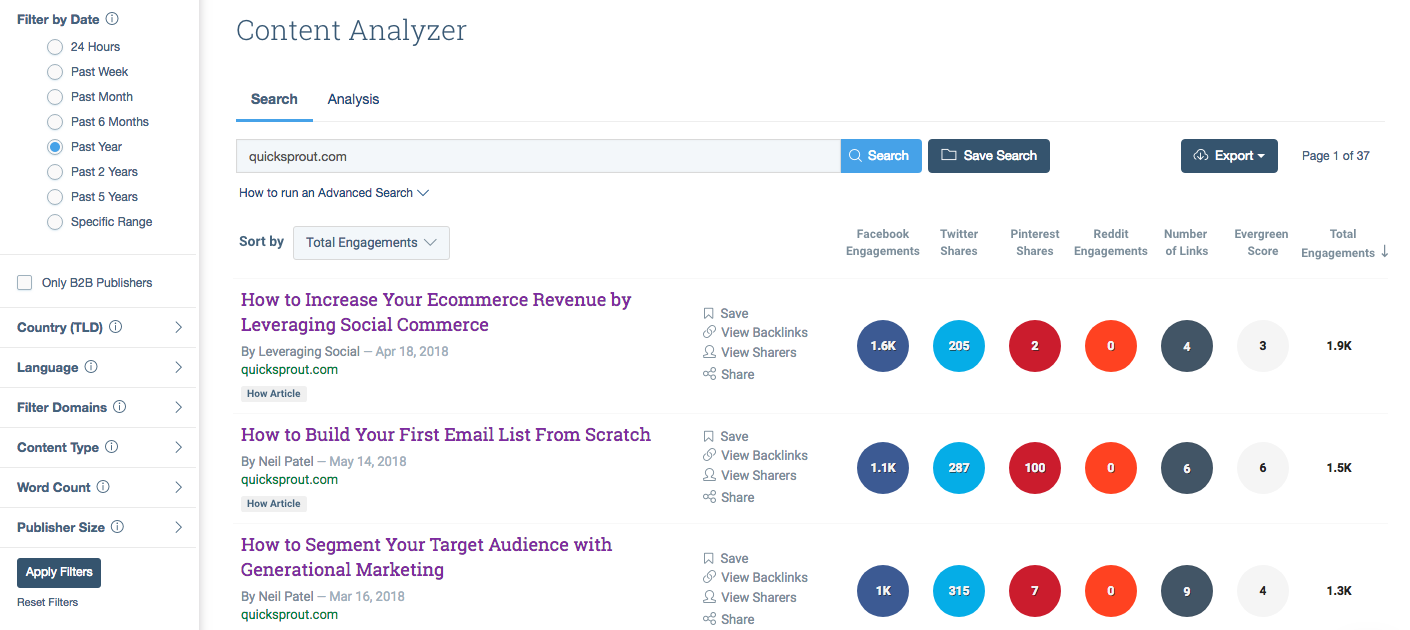
If you’re struggling to find what you need, try using Buzzsumo to see which content had the highest engagement on social media. Here’s what the content analyzer tool found when I put quicksprout.com into it:

buzzsumo

It shows me which posts from the past year were the most popular. But you can filter the time based on your needs.

In addition to Buzzsumo, you can use Google Analytics to see which pages on your website are the most popular.

After you analyze your content with these tools, make a list of your top performing publications and posts.

This will be your starting point. You’ll use this list to repurpose content.

For example, if you had a high performing blog post, you can turn it into a YouTube video. You could use a Facebook post with the highest number of likes on your Instagram story.

The ideas are seemingly endless. As we continue, I’ll give you some more examples of how you can proceed.

Build custom infographics

Going through your old posts, you want to find ways to repurpose them for even more engagement.

Here’s what I mean.

If you take an email newsletter that had the highest number of opens, click-throughs, and conversions and turn it into a blog post, the idea is that the blog post will be high-performing as well.

Otherwise, what’s the point? You don’t want to publish content just for the sake of publishing.

Your content needs to be actionable and drive engagement.

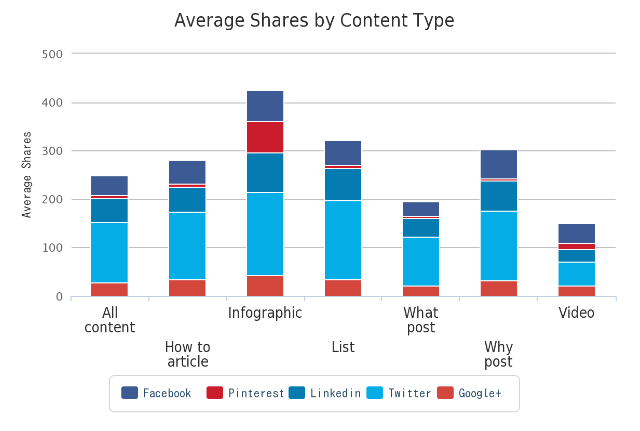
That’s why infographics are ideal for this strategy. Infographics are the most shared types of content across social platforms:

infographics

People are visual learners.

The graph above is a perfect example of that. Sure, I can tell you infographics get shared the most. But when I show you, it really sinks in and makes it easier for you to process.

Scan through all your top performing posts you identified earlier. Look for facts, statistics, or anything else that could be turned into a visual representation of the concept.

If you have never built an infographic before, don’t be intimidated. It’s not that difficult.

Refer to my post on how to enhance your content by building infographics for a list of tools that will make this process easy for you.

Once you create these infographics, you’ll have many options.

The same infographic can be used in different ways. You can:

  • add it to the original blog post, which can be republished
  • share it on social media
  • add it to your email newsletter
  • place it on your website
  • use it in a video slideshow

The list goes on and on.

Leverage your social media platforms

Your social media profiles have lots of benefits. They expose your brand to a wider audience and help you engage with your followers and customers alike.

Posting content on social media also helps you drive traffic to your website.

Anything you create gives you an excuse to post on social media.

If you haven’t been doing this, you need to do so moving forward. All your videos, infographics, and pictures are a must.

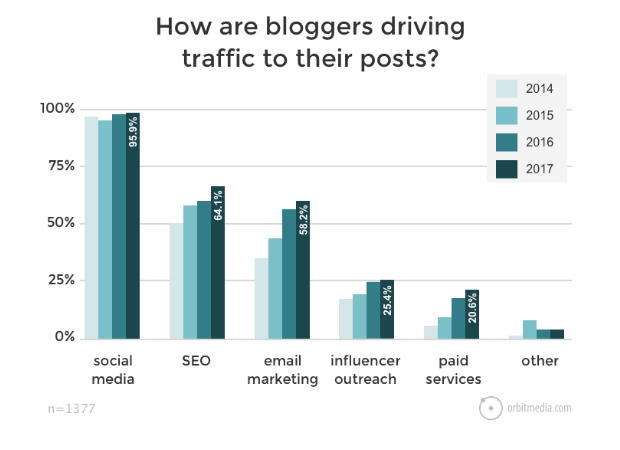
Social media is the number one way for publishers to drive traffic to their blog posts:

blogs social media

If you look at my Facebook page and my Twitter profile, you’ll see I use this strategy for all my blog posts.

It’s easy. Plus, it gives you an excuse to post something every day.

I’m shocked whenever I see businesses not using this tactic. They publish three or four blogs per week but struggle to come up with social media posts.

When you implement this strategy, plan your posts accordingly.

For example, there’s no reason to share the same blog post on all your social platforms simultaneously.

Spread out those promotions throughout the week. This will maximize your exposure and increase the chances of driving more traffic to your site.

Create more evergreen content

You can’t repurpose old content forever. At some point, you’ll need to create new pieces.

But you can make repurposing easier by creating evergreen content.

Are you familiar with this concept? Allow me to explain.

Simply put, evergreen content stays relevant for longer periods of time than regular content. Ideally, the majority of your content will be evergreen.

But it’s not realistic or likely that this will be the case for everything you create.

For example, last year, I wrote a post on top marketing trends to look for in 2018. Once 2019 comes, this post will lose its freshness.

When you write your evergreen content, you want to be as broad as possible. This post was fresh for an entire year. That wouldn’t be the case if it was the top trends to look for in January 2018. Do you see the difference?

Extremely specific content will only be relevant for a short period of time. Therefore, it’s more difficult for you to repurpose it.

Here’s another example. If you write a post about the Apple’s latest iOS update, it’s fresh only until a new version of the software is released. That’s not evergreen.

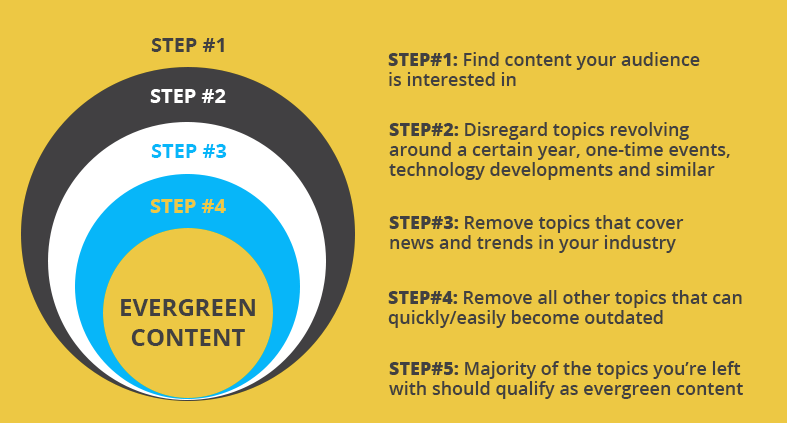
Here are some tips to help you find an evergreen topic:

evergreen

FAQ sheets are great for evergreen content.

Produce how-to guides or videos on topics that won’t be changing for years.

Clarify industry terms and concepts.

Again, I’m not saying you should be producing only evergreen content. That’s not realistic.

But if you publish an evergreen topic tomorrow, you could potentially repurpose it on another platform next year. That’s the idea.

Find the most interesting statistics you published

If you’re like me, you use statistics in your content all the time. Stats are a great way to back up any claims you’re making.

I recommend doing this because it proves your legitimacy and lets your audience know you’re not making things up.

But if you’re not repurposing content, those statistics get buried in your posts after they are published, never to be seen again.

Go back, and find the most interesting ones. In the future, keep a list of all statistics when you find them.

Then you can use them on other platforms.

Earlier, I talked about creating infographics. But that’s not the only way you can repurpose data.

Tweet a statistic. Use them in your Instagram captions. Include a stat in your email subject line. Post the most relevant ones on your website.

Get creative with this strategy.

Start a podcast

Podcasts are another great way to repurpose your content.

That’s because you have many different resources to work with there. All your blog posts and YouTube videos are viable options for a podcast.

You can summarize this content, nearly word for word, with your podcasts.

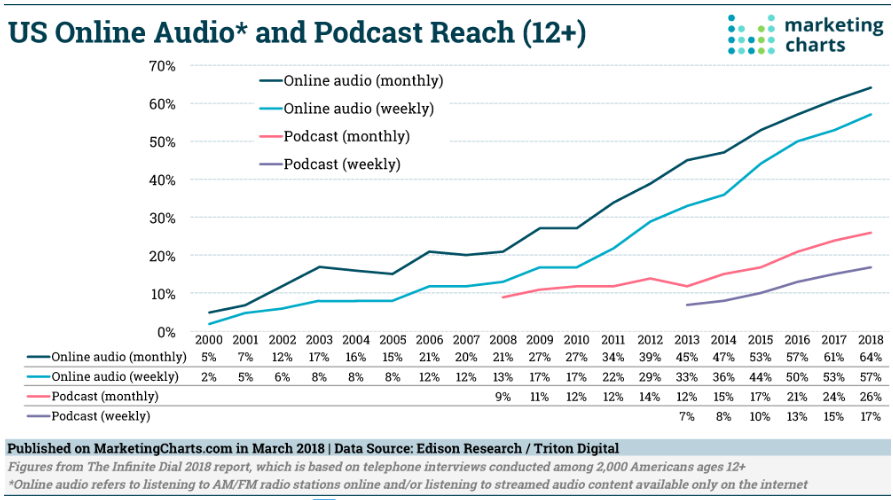
Since podcasts are growing in popularity, it’s a great way to reach an audience that doesn’t want to read blog posts or watch videos:

podcasts

Consider bringing a guest on your podcast to make things more interesting.

Have some fun with it. I try to keep this in mind with all my podcasts.

Fine-tune your writing skills

If you’ve got lots of audio, video, and visual content, you need to learn how to turn that into written content.

Start blogging more often. Write every day if you can.

It’s like anything else. The more you do something, the better you’ll get at it.

I wasn’t born a great blogger. It’s a learned skill.

Are some people better writers than others? Absolutely.

If you can’t find the time to write or can’t figure out how to write quality content, find someone on your team who can handle these responsibilities.

Once you’re able to write better, you can write a blog post about one of your YouTube videos, for example.

Keep things simple. Make your content easy for people to read and understand.

These are just some examples of things you can turn into written content:

  • webinars
  • podcasts
  • speeches from industry events
  • interviews

Encourage user-generated content

Your content isn’t the only type you can repurpose.

If you can find creative ways to encourage user-generated content, it will be easy for you to use this to your advantage as well.

Then all you have to do is sort through that user content and find the best pieces to repurpose for your needs.

Here’s an example of how GoPro encourages UGC on its website:

gopro

As you can see, it offers an incentive for people to submit their own content.

GoPro is giving away a million dollars, split between anyone who submits content that the company uses in a promotional video.

This saves the team a ton of time.

Instead of going out to different locations all over the world to shoot videos on their latest camera model, they put their customers to work instead.

Plus, they’ll be able to get way more footage this way as opposed to trying to do this on their own.

Once the videos are submitted, GoPro can repurpose them in a bunch of different ways. They can be used for advertisements, social media posts, YouTube videos, website content, and they can even be embedded in emails.

Come up with a similar strategy, and encourage your customers to submit pictures and videos.

I recommend using social media as a distribution platform for your UGC campaigns.

You can also find UGC without asking for it.

Sift through your comments.

Look at the comments on your social media pages and blog posts to see which ones can be repurposed.

If you notice similar comments or questions, use them to create an FAQ page.

Find your strongest introductions

Sometimes, all you need to do is repurpose a portion of your previously published content.

If you want to repurpose a short form of written content, I recommend using your post introductions.

If you need help with this, learn how to write blog post introductions that make the rest of your post irresistible.

Once you identified these top introductions, it’s easy to repurpose them.

Use an introduction from a blog post in an email newsletter. Use the same text in a YouTube video description.

Preview your introductions on social media. Here’s an example of how Conversion XL uses this strategy:

conversion XL

This also connects to one of my previous topics about leveraging your social media platforms.

Rather than posting a link with a CTA such as “check out my latest blog post,” consider using this strategy instead.

The text associated with the link would be the opening lines of the blog post introduction.

Conclusion

You don’t need to create new content every time you want to publish something new.

There are ways for you to use your existing content to your advantage. Just repurpose the work you’ve already done across all your distribution channels.

Start by identifying your best content. You’ll want to use that to increase your engagement metrics.

Build infographics. Share statistics. Post everything on social media.

Moving forward, create as much evergreen content as possible. This will make it easier for you to repurpose your content in the future.

Turn blog posts into podcasts. Use videos and other audio files to create posts.

Encourage user-generated content so you can repurpose it.

As you implement these strategies, you’ll realize you’re currently sitting on enough content to last you for months to come, as long as you can repurpose it effectively.

Use this guide as a reference to steer you in the right direction.

What type of content is your business repurposing on your distribution channels?

Quicksprout?d=yIl2AUoC8zA Quicksprout?d=qj6IDK7rITs Quicksprout?d=I9og5sOYxJI

source http://www.quicksprout.com/2018/10/31/how-to-repurpose-your-content-across-multiple-marketing-platforms/


source https://derekpackard.com/how-to-repurpose-your-content-across-multiple-marketing-platforms/

Why Social Media and Word of Mouth Are Not the Same Thing

why social media word of mouth not the same thing


Social media itself isn’t word of mouth — it’s one way that word of mouth spreads. #wordofmouth
Click To Tweet


In our social media-dominated world, most people have the impression that word of mouth has transitioned from in-person conversations to retweets and direct messages. They believe that social media IS word of mouth. Not true.

Social media garners plenty of attention and marketing budgets. But offline chatter is an equal, and sometimes more impactful, driver of awareness and preference.

It’s not that social media and online word of mouth don’t matter; they do. In fact, half of all word of mouth takes place online. However, research shows that offline word of mouth is more persuasive. According to a study by the Keller Fay Group, 50 percent of consumers say they are very likely to make a purchasing decision based on a real-life conversation. Meanwhile, 43 percent of consumers feel the same way after an online discussion.

It’s also important to understand that social media itself isn’t word of mouth; it’s one way that word of mouth spreads. Word of mouth is a story or verbal recommendation. Social media is a conveyance mechanism for that story. So is a review. So is a phone call. So is a conversation.

Thus, having a popular Instagram account is not the same as using thoughtful word of mouth. Likes and comments are quite different and less effective than word-of-mouth recommendations.

word of mouth vs social

The Math on Why Word of Mouth Matters

A single recommendation from an influencer spreads at an annual rate of eight factorial, according to Ted Wright, author of Fizz. Setting aside any complex math, a single recommendation passed from person to person over the course of a year ultimately reaches a total of 40,370 people. In other words, that recommendation from one person impacts 40,369 other potential customers.

We have LOTS more research on word of mouth in our new study, Chatter Matters: The 2018 Word of Mouth Report

What business wouldn’t want to cultivate these conversations and quickly multiply the number of people passing along positive recommendations? In spite of this potential, relatively few companies — think less than 1 percent — have an actual plan for word-of-mouth marketing.

Instead, most businesses are putting all their eggs in the social media basket. Social media budgets in the U.S. are projected to jump from $4.3 billion in 2012 to more than $23 billion in 2019. Even with this eye-popping spending spree, social media remains less effective than traditional person-to-person exchanges when it comes to word of mouth.

Offline conversations are incredibly powerful, though these discussions are difficult to track for your average marketing team. It’s hard to know if and when these comments happen. Jonah Berger, the author of Contagious, explains word of mouth perfectly:

You can shape it, you can encourage it, you can drive it, but you can’t buy it.

This might make it seem like generating word of mouth is impossible, but there’s a secret weapon for creating these organic conversations: talk triggers.

Give Them Something to Talk About

Establishing impactful word of mouth begins with giving people something they cannot help but talk about. It could be as simple as a cookie on a hotel pillow, funny hold music, or an unusually extensive menu.


Establishing impactful word of mouth begins with giving people something they cannot help but talk about. #TalkTriggers
Click To Tweet


These talk triggers are noteworthy experiences that your customers will rush to share with their friends and family members. Those people will then share that same story (or at least a close approximation of it) with their friends.

The good news? Your talk trigger can be just about anything. The only real criterion is that it must be remarkable enough to get noticed.

Confused about what is and isn’t a talk trigger? We talk about the four requirements for a talk trigger in my new book, written with Daniel Lemin:

A talk trigger must be:

  1. Remarkable
  2. Relevant
  3. Reasonable
  4. Repeatable

An Example of a Talk Trigger

One talk trigger with incredible longevity comes to us courtesy of the banking world. In this seemingly unremarkable industry where every bank offers pretty much the same services as the next one, brands must truly do something noteworthy to get people talking.

Umpqua Bank, headquartered in Portland, Oregon, is one of the 50 largest banking chains in the U.S. Each of Umpqua’s more than 300 locations prominently displays a silver telephone in its lobby. Since 1994, any customer can pick up one of these phones to be instantly connected with the company’s CEO. Not the manager of the branch or even the region — a direct line to the leader of the company.

It’s easy to imagine how this feature triggers conversations that positively affect the brand. Whenever a customer picks up the silver phone (whether he or she has something to say or is simply checking to see whether the phone actually works), president and CEO Cort O’Haver answers to create truly talk-worthy experiences.

Moving Beyond Social Media Buzz

Getting people talking and earning word-of-mouth recommendations involves more than chance — it requires a strategic plan. Andy Sernovitz, co-founder of the Word of Mouth Marketing Association, encourages marketers to see social and offline as valuable but different tools. Social is useful in that it is instantly shareable, but offline truly shines for its credible repeatability.

There’s nothing wrong with pairing the yin with the yang — offline and social in this case — but truly effective word-of-mouth marketing requires a lot more than a few buzzworthy tweets. Instead of throwing the bulk of your marketing dollars into the social media abyss, invest some of your valuable resources into creating truly noteworthy experiences. Your customers will be enamored, and their real-life networks will be more than happy to spread the word.

For more information on Talk Triggers, visit the official site, packed with free resources.

And, our team at Convince & Convert helps interesting brands create their own word of mouth strategy.

The post Why Social Media and Word of Mouth Are Not the Same Thing appeared first on Convince and Convert: Social Media Consulting and Content Marketing Consulting.

source https://www.convinceandconvert.com/word-of-mouth/social-media-vs-word-of-mouth/


source https://derekpackard.com/why-social-media-and-word-of-mouth-are-not-the-same-thing/

WordPress.com vs WordPress.org: What’s The Difference?

wordpress-com-vs-wordpress-org-1.jpg

What is the difference between WordPress.org and WordPress.com? This WordPress.com vs WordPress.org comparison will help you decide for your own blog.

The post WordPress.com vs WordPress.org: What’s The Difference? appeared first on How To Start A Blog.

source https://howtomakemyblog.com/wordpress-com-org/


source https://derekpackard.com/wordpress-com-vs-wordpress-org-whats-the-difference-5/